


Postgres-to-Iceberg CDC engine. Offload analytical queries from your production database without changing your application.
streambed streams WAL changes via logical replication, writes Parquet files to S3, and commits Iceberg metadata. Query the result with any Iceberg-compatible engine -- or use the built-in query server, which speaks the Postgres wire protocol so you can connect with psql.
Try the live Hacker News analytics demo →
Same analytical query on pgbench (1M accounts, 500K history rows). Postgres on the left, Streambed on the right.
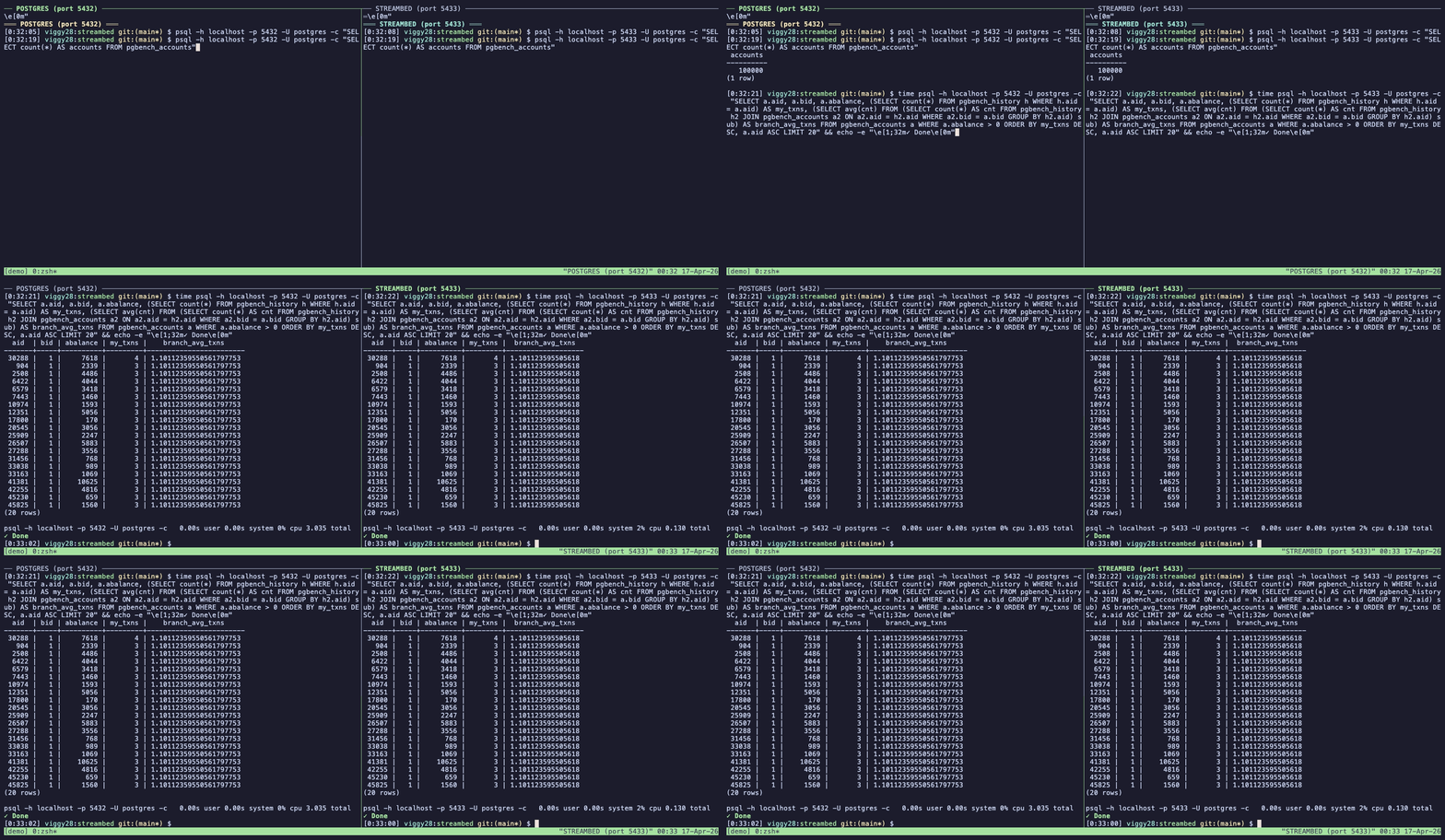
No ETL. No Spark. Just Postgres + S3.
Docker image (recommended)
Streambed publishes a Linux amd64 image to the GitHub Container Registry.
Use a version tag in production; latest tracks the newest stable release.
docker pull ghcr.io/viggy28/streambed:latest
docker run --rm ghcr.io/viggy28/streambed:latest --version
GitHub Release binary (Docker-free)
Each GitHub Release includes a
Linux amd64 binary archive and checksums. Download and extract the archive,
then run Streambed directly or supervise it with systemd.
See Deploy Streambed for production docker run and
systemd examples. Building from source is the contributor and development path;
see Development.
# Build Streambed and start it with Postgres + MinIO
# The streambed profile exposes the query server on localhost:5433.
docker compose --profile streambed up --build -d

# Query your Postgres tables via Iceberg
psql -h localhost -p 5433 -U postgres -d postgres
The container runs as a non-root user and stores its SQLite state and default
DuckLake catalog in the streambed-state volume. Stop the stack with
docker compose --profile streambed down; add --volumes to also remove that
state.
Run docker compose run --rm streambed sync --help for all configuration
options. All flags support environment variables with the STREAMBED_ prefix
(e.g. STREAMBED_SOURCE_URL). UPDATE/DELETE use copy-on-write by default; opt
into Iceberg v2 equality deletes with --mutation-mode=mor (or
STREAMBED_MUTATION_MODE=mor) after verifying reader compatibility. Once a
table has active equality deletes, Streambed fails startup in COW mode;
continue using MOR.
Use --target-file-size-mb (or STREAMBED_TARGET_FILE_SIZE_MB) to split large flushes into approximately target-sized Parquet data files. The default is 128 MiB. This is a target, not a hard maximum; small flushes still create small files.
To reduce load on your primary, point --source-url at a hot-standby replica and add --primary-url for the primary (used only for publication setup and metadata queries). Requires Postgres 16+. See docs/replica.md for details.
DuckLake catalog defaults
With --target-format=ducklake, Streambed stores catalog metadata in a local
DuckDB database by default:
~/.streambed/ducklake-catalog.duckdb
Parquet data remains under s3://<bucket>/<prefix>/ducklake/. Both catalog
settings can be overridden explicitly:
--ducklake-catalog=/path/to/catalog.duckdb \
--ducklake-catalog-store=duckdb
SQLite catalogs remain supported with --ducklake-catalog-store=sqlite.
Installations created before the DuckDB default must pass both legacy settings
to continue using their existing catalog; Streambed does not silently migrate
or overwrite it:
--ducklake-catalog="$HOME/.streambed/ducklake-catalog.sqlite" \
--ducklake-catalog-store=sqlite
The equivalent environment variables are STREAMBED_DUCKLAKE_CATALOG and
STREAMBED_DUCKLAKE_CATALOG_STORE.

Postgres WAL ──▶ Decode ──▶ Buffer ──▶ Parquet ──▶ S3 ──▶ Iceberg Commit
                                                              │
                                                    DuckDB ◀──┘ (query server)
Streambed connects to Postgres as a logical replication subscriber. It decodes WAL messages (inserts, updates, deletes), buffers rows per table, and periodically flushes them as Parquet files to S3 with Iceberg metadata commits. Updates and deletes use copy-on-write merging against existing Parquet data.
A query server exposes lakehouse tables over the Postgres wire protocol using embedded DuckDB, so you can query with psql or any Postgres client.
Streambed retains a snapshot at each lakehouse commit. Query a retained snapshot with DuckLake's native AT syntax:
SELECT o.id, c.name
FROM orders AS o AT (TIMESTAMP => TIMESTAMPTZ '2026-08-10 12:00:00')
JOIN customers AS c AT (TIMESTAMP => TIMESTAMPTZ '2026-08-10 12:00:00')
  ON c.id = o.customer_id;
Aliases must appear before AT. V1 supports historical joins, but every historical table in one query must use the same timestamp. Timestamp literals without an offset are interpreted as UTC; explicit offsets are also accepted. Queries without AT continue to read the latest state.
The timestamp is the Streambed flush/commit time, not the original Postgres transaction time. DuckLake snapshots are catalog-wide, while Iceberg snapshots are resolved independently per table to the latest retained snapshot at or before the requested time. Expired snapshots and their deleted files cannot be queried. Iceberg also has a known limitation: deleting or truncating every row currently clears that table's accessible snapshot history.
Inspect retained snapshots with:
./streambed snapshots --target-format=ducklake --table=public.orders
# or
./streambed snapshots --target-format=iceberg --table=public.orders \
  --s3-bucket=streambed --s3-prefix=test
| Command |
What it does |
streambed sync |
Main daemon. Streams WAL, writes Iceberg, optionally serves queries. |
streambed resync --table=public.users |
One-shot backfill via COPY under a consistent snapshot. |
streambed query |
Standalone query server (no sync). Points at existing lakehouse tables. |
streambed snapshots --table=public.users |
Lists retained snapshots and Streambed commit metadata. |
streambed cleanup --table=public.users |
Deletes S3 objects and state for a table. Useful before resync. |
streambed maintenance --table=public.users |
Expires old Iceberg snapshots and can dry-run orphan planning. |
streambed maintenance compact --table=public.users |
Compacts many small active data files into fewer target-sized files. |
See docs/maintenance.md for snapshot expiration and small-file compaction details.
Requires Go 1.22+ and CGO (for go-duckdb and go-sqlite3).
# Build
go build -o streambed ./cmd/streambed

# Unit tests
go test ./internal/... ./config/...

# Integration tests (requires Docker)
./scripts/test-integration.sh
Integration tests use the integration build tag and run against Postgres (port 5434) and MinIO (port 9002) from test/integration/docker-compose.yml.


