
Note
This is an ESM only package that requires a tsconfig with a module resolution that can read package.json#exports (NodeNext if transpiling with tsc, Bundler if using a bundler).
# Core package, no framework specific features
bun add envin

# CLI, used e.g. for live previews
bun add @envin/cli
For full documentation, see https://envin.turbostarter.dev
This package supports the full power of most popular schema libraries, meaning you can use transforms and default values.
// env.config.ts
import { defineEnv } from "envin";
import * as z from "zod";

export default defineEnv({
  /*
   * Shared environment variables, available on the client and server.
   */
  shared: {
    NODE_ENV: z.enum(["development", "production"]).default("development"),
  },
  /*
   * Prefix for client environment variables.
   */
  clientPrefix: "NEXT_PUBLIC_",
  /*
   * Environment variables available on the client (and server).
   *
   * 💡 You'll get type errors if these are not prefixed with NEXT_PUBLIC_.
   */
  client: {
    NEXT_PUBLIC_API_URL: z.url(),
  },
  /*
   * Serverside Environment variables, not available on the client.
   * Will throw if you access these variables on the client.
   */
  server: {
    DATABASE_URL: z.url(),
  },
  /*
   * In some cases, we need to manually destructure environment variables to make sure all are included in bundle.
   *
   * 💡 You'll get type errors if not all variables are included here.
   */
  envStrict: {
    DATABASE_URL: process.env.DATABASE_URL,
    NEXT_PUBLIC_API_URL: process.env.NEXT_PUBLIC_API_URL,
  },
});
Use the schema in your app with autocompletion and type inference
// route.ts
import env from "~/env.config";

export const GET = (req: Request) => {
  const DATABASE_URL = env.DATABASE_URL;
  // use it...
};One of the most powerful features of this package is the ability to preview your environment variables in a livemode.
# Run the CLI with your env.config.ts file
npx @envin/cli@latest dev
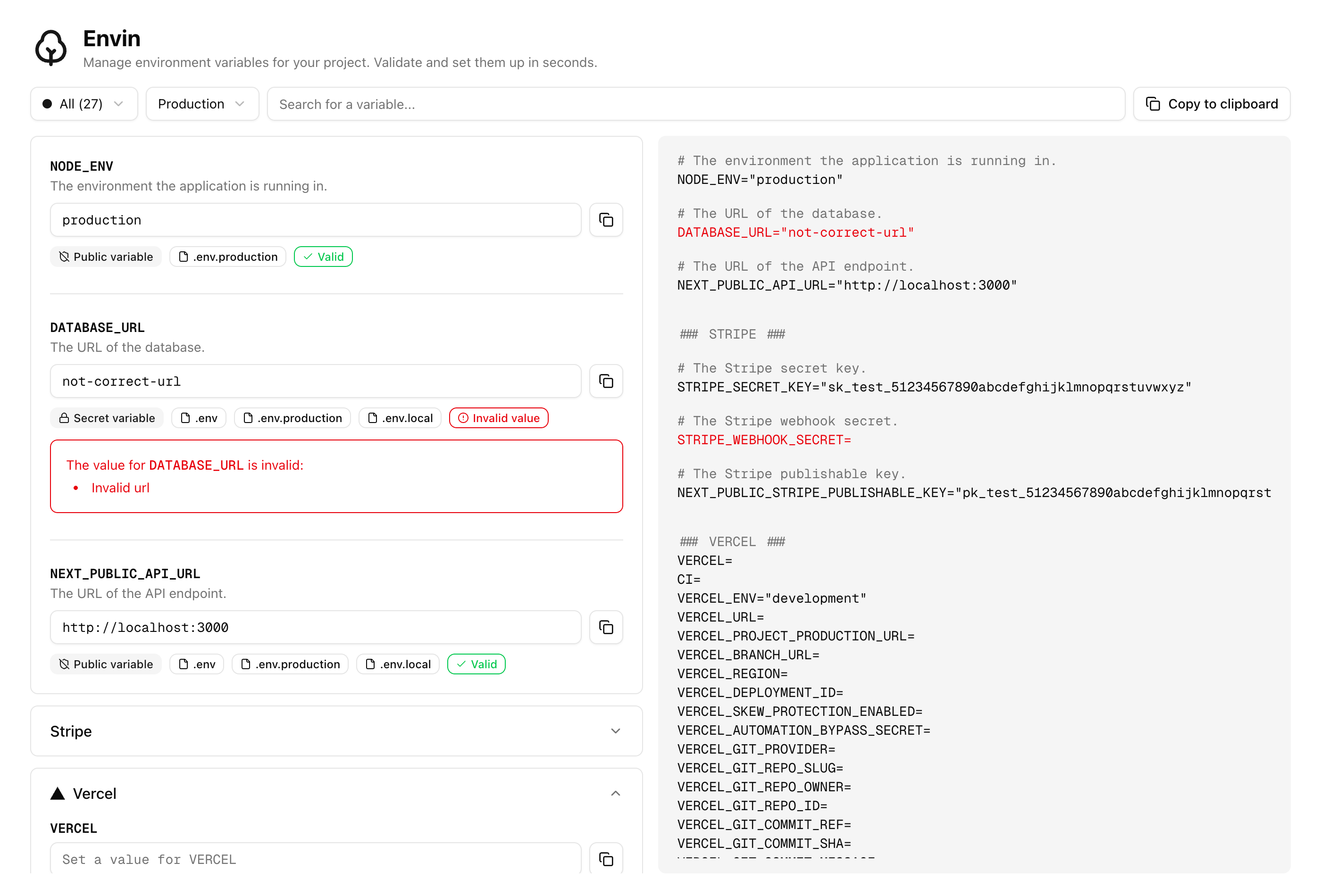
This will start a live preview server that will automatically update your environment variables when you change them allowing you to find and fix errors before deploying your app.
npx @envin/cli@latest dev [options]
Options:
-c, --config <path>: explicit path to env.config.ts-e, --env <path...>: path(s) to .env file(s) or directories-p, --port <port>: port to run the preview server (default: 3000)-v, --verbose: enable verbose logging
The CLI uses the following precedence within each directory:
.env → .env.local → .env.development → .env.development.local.env → .env.local → .env.production → .env.production.local
If -e points to a single file, only that file is used. If -e points to a directory, only that directory is used. If multiple paths are provided, they must all be files or all be directories. Without -e, the CLI uses the current working directory.
See CONTRIBUTING.md.

