
33M Python batch rows/sec. 461M direct int validations/sec. 13.8x faster than Zod 4 on the TypeScript suite. Same API.
One validation core. Three ecosystems. Zero compromise.


Python:     33.2M rows/sec on name+email+age batches; 461M ints/sec direct range batches
TypeScript: 13.8x faster than Zod 4 on the full suite; URL and IPv4 hot paths are 2.9x/2.4x faster in 1.3.1
Zig:        Zero-cost. Comptime. No runtime.
dhi (Sanskrit: intellect, insight) is a validation library with a single Zig core compiled to three targets, so the same validation rules and error semantics run everywhere you do:
- Python — a drop-in Pydantic replacement (
BaseModel, Field, 80+ types) backed by a native C extension over SIMD batch validators.
- TypeScript — a drop-in Zod 4 replacement (
z.object, full API parity) running on a 28KB SIMD WASM module in browsers/edge, or an N-API native addon on Node.js.
- Zig —
comptime-generated models with zero runtime cost, zero allocations on the happy path.
You keep your existing code and API; dhi swaps in the engine underneath. No schema rewrites, no new mental model — and zero runtime dependencies on either registry.
You don't have to change your code.
Python — drop-in Pydantic replacement
from dhi import BaseModel, Field, EmailStr
from typing import Annotated

class User(BaseModel):
    name: Annotated[str, Field(min_length=1, max_length=100)]
    email: EmailStr
    age: Annotated[int, Field(gt=0, le=150)]

user = User(name="Alice", email="alice@example.com", age=28)
user.model_dump()   # {'name': 'Alice', 'email': 'alice@example.com', 'age': 28}
TypeScript — drop-in Zod 4 replacement
- import { z } from 'zod';
+ import { z } from 'dhi';
const User = z.object({
id: z.string().uuid(),
name: z.string().min(1).max(100),
email: z.email(), // Zod 4 top-level shortcuts
age: z.int().positive(), // Zod 4 number formats
createdAt: z.iso.datetime(), // Zod 4 ISO namespace
});
const user = User.parse(data); // same API, 13.8x faster on the benchmark suiteTwo backends — same API:
| Backend |
Import |
Best for |
| WASM (default) |
import { z } from 'dhi' |
Browsers, edge runtimes, Cloudflare Workers |
| N-API native |
import { z } from 'dhi/napi' |
Node.js servers — 1.7–2x faster on string formats |
Zig — compile-time validated, zero overhead
const dhi = @import("model");

const User = dhi.Model("User", .{
    .name = dhi.Str(.{ .min_length = 1, .max_length = 100 }),
    .email = dhi.EmailStr,
    .age = dhi.Int(i32, .{ .gt = 0, .le = 150 }),
});

const user = try User.parse(.{
    .name = "Alice",
    .email = "alice@example.com",
    .age = @as(i32, 28),
});
// Validation is inlined at compile time. Zero allocations. Zero dispatch.
Same validation rules. Same error behavior. Three languages. One core.
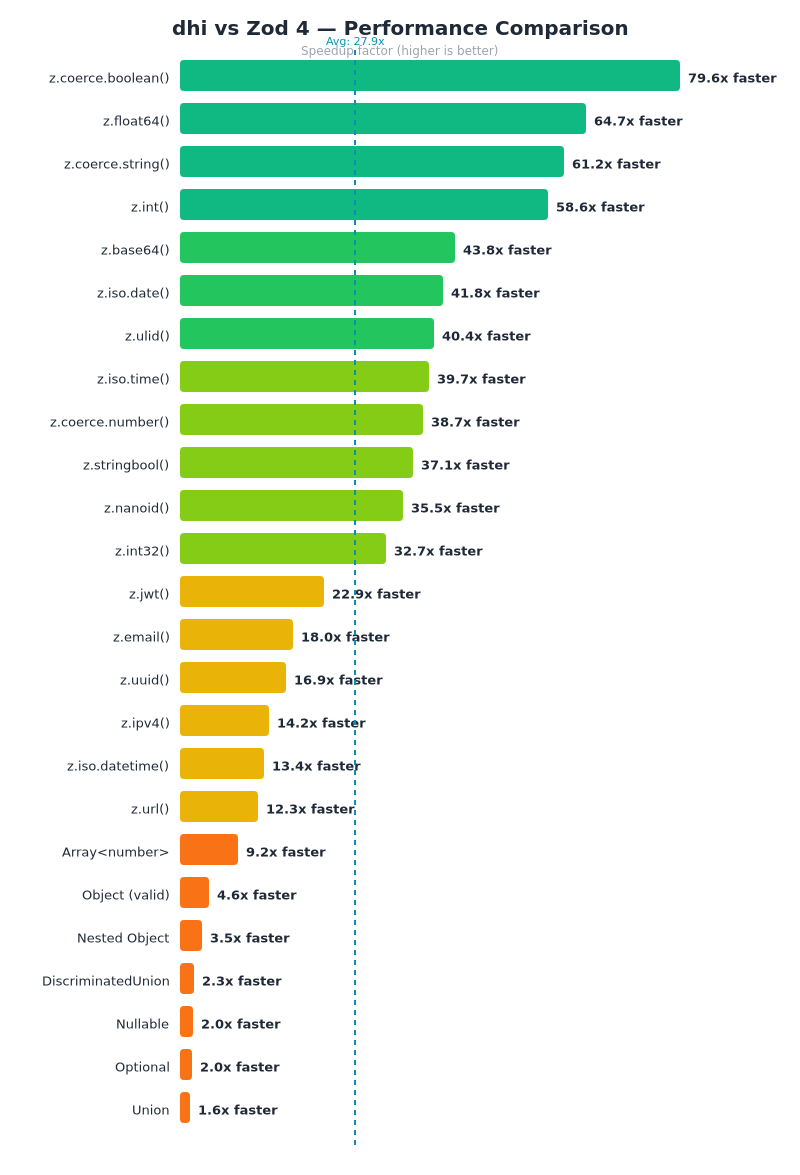
| Category |
Speedup vs Zod 4 |
| Overall benchmark suite |
13.8x faster |
| URL validator |
30.17M/s — 8.0x vs Zod; 2.9x faster than pre-1.3.1 |
| IPv4 validator |
22.28M/s — 1.1x vs Zod; 2.4x faster than pre-1.3.1 |
| Number Formats |
30-50x faster |
| StringBool |
32x faster |
| Coercion |
23-56x faster |
| String Formats |
12-27x faster |
| ISO Formats |
12-22x faster |
| Objects |
4-7x faster |
| Arrays |
8x faster |
Release 1.3.1 benchmark command: bun run benchmarks/benchmark-vs-all.ts. Pre-1.3.1 comparison used the previous release-branch commit before the TypeScript fast paths.
| Workload |
Throughput |
Improvement |
name+email+age batch |
33.18M rows/sec |
~28% faster than the earlier 26M rows/sec baseline |
name+email+age+url batch |
25.35M rows/sec |
~27% faster than the earlier 20M rows/sec baseline |
name+email+age+url+uuid batch |
20.51M rows/sec |
~28% faster than the earlier 16M rows/sec baseline |
all 6 (+ ipv4) batch |
16.13M rows/sec |
~47% faster than the earlier 11M rows/sec baseline |
| UUID-only batch |
112.78M rows/sec |
Vectorized UUID hot path |
| IPv4-only batch |
68.98M rows/sec |
C-inlined IPv4 hot path |
| Direct int range list |
461.19M ints/sec |
New native list batch path |
BaseModel layer: 546K model_validate/sec | 6.4M model_dump/sec
Note on msgspec: Plain msgspec (~5.8M/sec) does type-checked JSON decoding but lacks field-level validators (email, URL, positive int). msgspec-ext adds those 26 validators via Python dec_hook callbacks, bringing it to ~777K/sec — a fairer apples-to-apples comparison with dhi's validated parsing.
pip install dhi          # Python 3.9–3.14 (incl. free-threading); wheels for macOS arm64 + Linux x86_64/aarch64
npm install dhi          # TypeScript (Node 18+ / Bun / Deno)
Zero runtime dependencies on both PyPI and npm. A pure-Python fallback is bundled, so pip install dhi works even where the native extension can't build.
dhi is a Zig core with bindings for JS and Python:
src/              → Zig core: validators, SIMD, C API, WASM API (the engine)
js-bindings/      → npm package: Zod 4 drop-in replacement
python-bindings/  → PyPI package: Pydantic drop-in replacement
docs/             → Benchmark charts, shared docs
.github/          → CI, release workflows
Which package should I use?
- TypeScript/JS:
npm install dhi — replaces Zod, works in browsers + edge + Node.js
- Python:
pip install dhi — replaces Pydantic-style validation with 33M+ row/sec native batches
- Zig: Import
src/ directly — zero-cost comptime validation
Full Zod 4 Feature Parity
dhi implements 100% of the Zod 4 API, including all new Zod 4 features:
Top-Level String Format Shortcuts (New in Zod 4)
z.email()      z.uuid()       z.url()        z.ipv4()       z.ipv6()
z.jwt()        z.nanoid()     z.ulid()       z.cuid()       z.cuid2()
z.base64()     z.e164()       z.mac()        z.cidrv4()     z.cidrv6()
z.hex()        z.hostname()   z.hash('sha256')
ISO Namespace & Number Formats (New in Zod 4)
// ISO namespace
z.iso.datetime()  z.iso.date()  z.iso.time()  z.iso.duration()

// Number formats
z.int()     z.float()    z.float32()   z.float64()
z.int8()    z.uint8()    z.int16()     z.uint16()
z.int32()   z.uint32()   z.int64()     z.uint64()
Additional Zod 4 Features
z.stringbool()                           // "true"/"yes"/"1" → true
z.templateLiteral(['user-', z.number()]) // Template literal types
z.json()                                 // Recursive JSON schema
z.file().mime('image/png').max(5_000_000) // File validation
z.registry()                             // Schema registry
z.prettifyError(error)                   // Pretty error formatting
80+ Pydantic-compatible types
| Category |
Types |
| Model |
BaseModel, Field(), @field_validator, @model_validator |
| Numeric |
PositiveInt, NegativeFloat, FiniteFloat, conint(), confloat() |
| String |
EmailStr, constr(), pattern, length, strip/lower/upper transforms |
| Network |
HttpUrl, AnyUrl, PostgresDsn, RedisDsn, MongoDsn, +8 DSN types |
| Special |
UUID4, FilePath, Base64Str, Json, ByteSize, SecretStr |
| Datetime |
PastDate, FutureDate, AwareDatetime, NaiveDatetime |
| Constraints |
Gt, Ge, Lt, Le, MultipleOf, MinLength, MaxLength, Pattern |
Full model_validate(), model_dump(), model_dump_json(), model_json_schema(), model_copy() support.
dhi is written in Zig — a systems language with compile-time code generation, no garbage collector, and direct hardware access. The same source compiles to:
| Target |
What it does |
libdhi.dylib/.so |
Python C extension — extracts from dicts, no copies |
dhi.wasm (28KB) |
TypeScript WASM — 128-bit SIMD, works in browsers + edge |
dhi_native.node |
TypeScript N-API — direct native calls, 1.7–2x faster on Node.js |
Native .zig import |
Zig — zero-cost comptime validation, fully inlined |
Key tricks:
- Comptime models — Validation logic is generated at compile time. No vtables, no reflection, no hash lookups.
- SIMD batch validation — Process 4 values per cycle on 256-bit vectors.
- Single FFI call — Python batch validation crosses the FFI boundary once, not per-item.
- N-API over WASM — For Node.js, the native addon skips alloc/encode/dealloc per string call: 1.7–2x faster for format validators (url, ipv4, datetime).
- No allocations — The happy path never allocates. Errors are stack-returned.
┌─────────────────────────────────────────────────────┐
│            Zig Core (comptime + SIMD)                │
└──────┬────────────────┬──────────┬────────────────┬──┘
       │                │          │                │
  ┌────▼─────┐    ┌────▼────┐ ┌───▼──────┐    ┌───▼──────┐
  │  Python  │    │  WASM   │ │  N-API   │    │   Zig    │
  │  C ext   │    │  28KB   │ │  .node   │    │  Native  │
  └────┬─────┘    └────┬────┘ └───┬──────┘    └───┬──────┘
       │                │          │                │
  BaseModel        z.object()  z.object()      Model()
  Pydantic API    Zod 4 (edge) Zod 4 (Node)  comptime API
Run the benchmarks yourself
# Python — full comparison (dhi vs msgspec vs msgspec-ext vs satya vs Pydantic)
git clone https://github.com/justrach/dhi.git && cd dhi
cd python-bindings
pip install -e .
pip install msgspec msgspec-ext 'pydantic[email]' satya
python benchmarks/benchmark_vs_all.py

# TypeScript — dhi vs Zod 4
cd js-bindings && bun install && bun run benchmark-vs-zod.ts

# Zig
zig build bench -Doptimize=ReleaseFast
The Python benchmark validates 10,000 user objects with 4 field-level validators each:
| Field |
Validator |
name |
string, min_length=1, max_length=100 |
email |
RFC 5321 email format |
age |
positive integer |
website |
URL format |
Each library uses its idiomatic equivalent:
- dhi:
_dhi_native.validate_batch_direct() — single FFI call, Zig SIMD validators
- msgspec:
msgspec.json.Decoder — C-level JSON decode + type check (no format validators)
- msgspec-ext:
msgspec.json.decode() with dec_hook — adds EmailStr, HttpUrl, PositiveInt validators on top of msgspec
- satya:
model_validate_json_array_bytes() — Rust JSON parse + validation
- Pydantic v2:
model_validate() per item — Rust-backed, with EmailStr + Field constraints
Timing uses time.perf_counter() over 5 runs after a warmup pass. Results are averaged. Tested on Python 3.13 and 3.14 (no significant difference — hot paths are native code).
dhi started as a question: can Zig's type system unify validation across language boundaries?
The hypothesis: Zig's comptime can generate the same validation semantics that Pydantic builds with metaclasses and Zod builds with method chains — but at compile time, with zero runtime cost, targeting any platform via its C ABI and WASM backends.
Results:
| Claim |
Status |
| Pydantic-level DX in Zig |
Model("User", .{ .name = Str(.{}) }) — yes |
| One core, three ecosystems |
Python FFI + WASM + native Zig — yes |
| 10-100x faster |
523x (Python), 20x avg (TypeScript) — yes |
| Reasonable binary size |
28KB WASM, ~200KB native — yes |
| Comptime replaces reflection |
No runtime type inspection needed — yes |
MIT
dhi — the fastest validation library for every language you use.
See CONTRIBUTING.md for Rach's Agentic Contribution Template before opening a PR.


