A hybrid-enforced multi-agent orchestration pipeline. The pattern is portable; the reference implementation targets ZCode.
What if the "review the plan before executing" step in your agent pipeline was a hard gate, not a suggestion?
That is the core idea. Most multi-agent orchestrators (including the excellent omo, which this project learned from) implement the review/approval gate as a prompt convention — the model is told not to edit before review passes, but nothing actually stops it. ZOdyssey code-enforces that gate with a hook, and adds a scope-isolation boundary so an executor can only touch files the plan declared. The full pipeline (prime → triage → consult → plan → review → execute → verify → final-wave) is the same shape omo and others use; the enforcement layer is the delta.
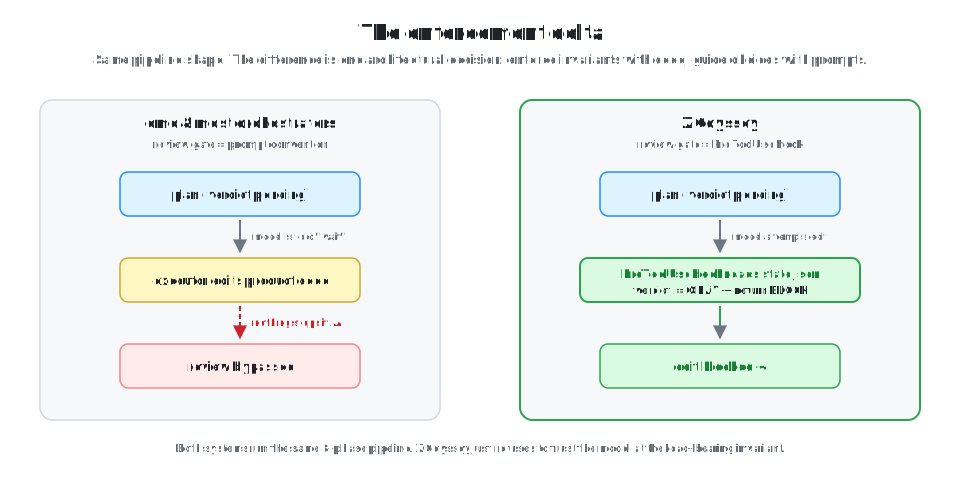
Both sides run the same pipeline. The right side just refuses to trust the model at the load-bearing invariant.
Why code-enforced orchestration
ZOdyssey is a code-enforced orchestration pipeline for ZCode (for now — the pattern is harness-portable): the review gate, executor scope isolation, and parallel dispatch caps are enforced by hooks, not prompt conventions. The pipeline shape — prime → triage → consult → plan → review → execute → verify → final-wave — is the shape multi-agent orchestrators already share; the delta is that the load-bearing invariants are checked by code instead of trusted to the LLM's good behavior, from plan-review onward.
Most frameworks tell their AI agents what not to do: don't edit before the plan passes review, don't touch files outside the declared scope, don't fan out past the concurrency budget. A prompt convention is a suggestion to an LLM under pressure. ZOdyssey's enforcement hook reads the run state, the plan's declared file list, and the in-flight dispatch count, and blocks the tool call when an invariant would break — so the developer tools and repos behind the pipeline keep their guarantees even when an agent is confused or lazy.
The honesty is part of the design: a "What it is NOT" section lists what the pipeline does not claim to be, documentation citations are lock-pinned so a drifted file:line anchor fails the test suite, and a todo cannot be marked done without recorded, executed evidence. The pattern is portable to any harness with hooks — the design and adaptation guides below cover both the ideas and the reference implementation.
Two ways to use this repo
1. You just want the ideas (any harness)
Read docs/DESIGN.md — it explains the hybrid-enforcement principle, the plan-file contract, the state/resume model, and every load-bearing decision with the research it is grounded in. Then read docs/ADAPT.md for a concrete guide to porting the enforcement delta onto omo or any orchestrator that supports hooks (Claude Code, ZCode, Cursor, etc.). The source of the gate itself (skills/odyssey/hooks/pre-tool.mjs) is the reference implementation to crib from.
If you are already an omo user, start there — omo gives you the full pipeline, the agent cast, and the ergonomics. Then layer on the 4 enforcement hooks from docs/ADAPT.md. That is the highest-leverage path for most people.
2. You are on ZCode and want it ready-to-run
Install the reference implementation:
git clone https://github.com/amartinawi/zodyssey.git
cd zodyssey
node scripts/install.mjs            # configures pipeline MCPs + AGENTS.md + purges legacy state
Then install the plugin itself via the ZCode marketplace (it owns the cache + the manifest, including the enforcement hooks): Settings → Plugin Management → Discover → + → local directory → <path>/zodyssey → Get on zodyssey. Hooks are declared in .zcode-plugin/plugin.json and load automatically — no config.json surgery.
Then start a new ZCode session and run, in any repo:
Full install/troubleshooting/config in docs/INSTALL.md.
flowchart TD
    P["−1 · PRIME<br/><i>prompt-master</i>"] --> T{"0 · TRIAGE"}
    T -- trivial --> SKIP["just answer normally"]
    T -- standard / architecture --> C["1 · CONSULT <b>metis</b>"]
    C --> PL["2 · PLAN <b>prometheus</b>"]
    PL --> R{"3 · REVIEW <b>momus</b>"}
    R -- "REJECT (round < 3)" --> PL
    R -- OKAY --> E["4 · EXECUTE <b>sisyphus-junior</b><br/>parallel waves, capped at 4"]
    E --> V["5 · VERIFY<br/>acceptance commands"]
    V --> CMP["automatic for large runs<br/>compact.mjs<br/>summarize notepads"]
    CMP --> F{"6 · FINAL WAVE<br/>F1·F2·F3·F4·F5"}
    F -- pass --> DONE(("done"))
    F -- fail --> E
    classDef gate fill:#ffebe9,stroke:#cf222e,stroke-width:2px;
    classDef good fill:#dafbe1,stroke:#2da44e,stroke-width:2px;
    classDef phase fill:#ddf4ff,stroke:#218bff;
    class R gate;
    class DONE good;
    class C,PL,E,V,P phase;
Loading
The conductor drives this state machine; every transition checkpoints to state.json so a crashed run resumes. Full topology + agent roles in docs/diagrams.md.
  -1  PRIME        prompt-master refines the raw task into a sharp brief;
                    measurable criteria get ONE user-confirmation round (never blocks)
   0  TRIAGE       trivial → just answer; standard → single-track; architecture → full pipeline
   1  CONSULT      metis classifies intent, surfaces questions/risks
   2  PLAN         prometheus writes <repo>/.zcode/plans/<slug>.md  (cannot edit product code)
   3  REVIEW       momus returns OKAY | REJECT + blockers   ←  THE ENFORCED GATE
   4  EXECUTE      sisyphus-junior per todo, parallel-by-default, scope-locked to the plan's Files:
   5  VERIFY       run each todo's executable acceptance criteria
      automatic   compact.mjs — fires at final entry for large runs; F1–F5 consume a brief, not the full doc set
   6  FINAL WAVE   F1 plan-compliance · F2 code-quality · F3 manual-QA · F4 scope-fidelity · F5 capability-routing
The orchestrator (main agent) drives this; the cast of sub-agents (metis, prometheus, momus, sisyphus-junior, plus read-only explore/librarian/oracle) does the work. The enforcement hooks are declared in .zcode-plugin/plugin.json under hooks (resolved via ${CLAUDE_PLUGIN_ROOT}) and hard-block the invariants.
What the hooks enforce (the delta)
flowchart TD
    A(["tool call"]) --> B{"run active?"}
    B -- no --> P1["✓ pass (no-op)"]
    B -- yes --> K{"tool kind"}
    K -- "Edit / Write" --> S{"in plan's<br/>declared Files: ?"}
    S -- no --> X1["✗ BLOCK scope"]
    S -- yes --> L{"file-lock<br/>free?"}
    L -- no --> X2["✗ BLOCK collision"]
    L -- yes --> V{"verdict<br/>== OKAY?"}
    V -- no --> X3["✗ BLOCK review gate"]
    V -- yes --> P2["✓ pass"]
    K -- "Task / Agent" --> C{"within<br/>parallel cap?"}
    C -- no --> X4["✗ BLOCK cap"]
    C -- yes --> P3["✓ dispatch"]
    K -- "Bash (write-capable)" --> V
    K -- "MCP / non-native" --> M{"targets the<br/>enforcement subtree?"}
    M -- yes --> X5["✗ BLOCK containment"]
    M -- no --> P4["✓ pass"]
    classDef b fill:#ffebe9,stroke:#cf222e,stroke-width:1.5px;
    classDef g fill:#dafbe1,stroke:#2da44e;
    classDef d fill:#fff8c5,stroke:#d4a72c;
    class X1,X2,X3,X4,X5 b;
    class P1,P2,P3,P4 g;
    class B,K,S,L,V,C,M d;
Loading
First match wins; every other branch blocks. The MCP/non-native arm landed in v0.5.4 — it is the tool class that could otherwise rewrite the gate itself from inside an approved run. Full decision tree (including the plan-tamper sha guard + the trusted-script allowlist) in docs/diagrams.md.
| Invariant |
How omo does it |
How ZOdyssey does it |
| No edits before plan passes review |
prompt convention |
hook reads state.json; blocks the Edit |
| Executor stays in declared scope |
not enforced |
hook parses the plan's Files: union; blocks edits outside it. Fails closed on unreadable/empty plan |
| No edit collisions between agents |
not enforced |
hook checks a file-lock ledger |
| Parallel dispatch within bounds |
not enforced |
hook counts in-flight Tasks; blocks beyond cap (default 4) |
| Bash write-escape before review |
n/a |
hook gates write-capable Bash (sed -i, >, git apply, …) the same as Edit. Secure by default; ZODYSSEY_UNGATE_BASH=1 disables (every ungated call is recorded in run state) |
| Embedded-dispatch injection (SEC-1s, v0.2.0) |
n/a |
hook blocks a Task() dispatch whose prompt payload embeds a serialized nested tool call — both {"tool_name":"Task"} and Claude-native {"type":"tool_use","name":"Task"} shapes. Defense-in-depth behind the harness tool-grant boundary. |
| Review verdicts are read, not assumed |
prompt convention |
F2/F4 parse the artifact's verdict. Ambiguous or absent → missing → fails. The nonce is minted only for the exact declared minter type, never for a lookalike namespace. Previously they confirmed a nonce and never opened the file |
| Tests can't be weakened to pass |
not enforced |
F1 fails on a deleted test file, a net-negative test-file line count, or a newly added skip/only/xfail. Test files are read-only during verify/final |
| The declared work actually happened |
not enforced |
F1 checks the converse: a plan declaring files against an empty diff fails instead of passing vacuously |
| Evidence can't be destroyed |
not enforced |
notepads are append-only — Write over an existing one is blocked, Edit is not |
done requires executed evidence |
not enforced |
record-todo refuses done without passing verify.history records; --force-done is allowed but stamps forced: true |
| No pass-to-pass regressions |
not enforced |
the pass-to-pass property, wired both sides as of v0.6.17 (queue item 24). The suite is baselined at execute entry (set-phase.mjs:363, idempotent; record-review.mjs captures the same on its OKAY advance), and the done transition itself runs regression-gate.mjs --check (set-phase.mjs:305) over the exact tree the final wave judged, re-reads the state, then refuses on regressed and toolchain-drift (set-phase.mjs:132, :138) — the invoke half this row shipped without until item 24. An already-red suite is never blamed on the run; no toolchain degrades to inert, never a block |
| Imports resolve |
not enforced |
check-imports.mjs flags packages in neither the manifest nor node_modules, offline, exiting 9. Wired both sides in v0.6.0 (queue item 02): invoked at verify entry (set-phase.mjs:404), recorded to state.imports, consumed by a done refusal on status === "unresolved" (set-phase.mjs:153). inert and a missing lane still pass, so it cannot wedge a repo it can't evaluate |
| No retrying an unchanged workspace |
not enforced |
record-verify refuses to re-run a criterion whose worktree is byte-identical to its last failure (exit 10). Ported from prime-agent |
| Citations still point where they claim |
not enforced |
every number of every citation shape — single lines, ranges, comma chains, slash and bare-colon continuations — is range-checked and content-pinned in scripts/anchors.lock.json (743 citations across 68 documents, measured 2026-08-24 post-re-baseline; one --update re-baseline per release re-pins them after at-source verification). Accepted under-coverage: a bare :N continuation with no same-line path-form antecedent is not discovered, so it is neither range-checked nor pinned — discovered shapes only. Citations into CHANGELOG.md are content-pinned like any other target: its top section is scanned while released history below the second version heading stays frozen, and check-anchors.test.mjs fails npm test when a cited line changes. Pins content, not line numbers, so an in-place edit is caught too. The lock proves unchanged since seeding, never correct: re-seeding a citation whose meaning moved silences it |
| Non-native tools can't write the enforcement surface (v0.5.4) |
n/a |
Edit and Bash were already gated, leaving MCP/non-native tools as the last class that could rewrite the gate from inside an approved run. The H3 guard in pre-tool.mjs blocks them from skills/odyssey, agents, commands, the manifest and the hook registry. Read-only MCPs and ordinary repo work are unaffected |
| Every run records who verified it (v0.6.0) |
not enforced |
each run-report and trend record carries verify_origin (external-audit | in-session-only) plus consult_rounds. Labeling only, no gate — but an externally audited run and a self-graded one are no longer indistinguishable in the corpus |
| Reviewer reliability is measured, not assumed (v0.6.0) |
not enforced |
registry-report.mjs folds consult verdicts + judge criterion results into a cross-run trust ledger keyed on agent-file content hashes, so editing a prompt creates a new identity rather than inheriting its predecessor's record. Laplace-smoothed with n always shown; advisory-only |
| The metrics corpus holds real runs only (v0.6.1) |
n/a |
ZODYSSEY_EVAL_LANE=synthetic, declared at source, routes fixture scorecards to results.synthetic.jsonl; the operator lane takes real runs. Before this, 83.2% of the trend log was fixtures being read as evidence |
| Absent telemetry explains itself (v0.6.3) |
n/a |
collectRunTokens returns {inert:true, reason, node_version, at} over a closed reason set instead of a bare null, so a dead collector is distinguishable from a healthy one. Attribution upgrades to session-exact when the orchestrator session id was witnessed. Needs Node ≥ 22.5 for node:sqlite; below that the record says binding-unavailable rather than going quiet |
| A synthetic generator declares its lane at every producer site (v0.6.15) |
not enforced |
the eval harness (skills/odyssey/scripts/harness.mjs) tags every spawn that can reach set-phase.mjs with ZODYSSEY_EVAL_LANE: "synthetic" (spreading ...process.env first) and routes its baseline arm's direct self-append to results.synthetic.jsonl via an unconditional constant — closing the leak the harness itself had reopened through the one append path no spawn env can reach. The regression suite proves the inversion hermetically, immune to an inherited lane variable |
| Each tool call is judged by the project it touches (v0.6.16) |
not enforced |
per-call project-scoped run selection: one workspace holding several projects no longer lets a single "active run" govern every check. Protected dirs are the union across runs (a cleared gate in project-a cannot admit writes into project-b's state), ledger/probe routing follows the targeted project, the full-runs cache is TTL-bounded so a project created mid-window becomes visible, one shared plan-path resolver fail-closes foreign/absolute plan paths, and scaffold stamps a project binding the discovery walks enforce — pre-0.6.16 markers verify byte-identically. Design: docs/DESIGN.md §6.2 |
| Every trend record names its emitter (v0.7.2) |
n/a |
each emitted record carries zodyssey_version, read self-relative from the executing copy's own .zcode-plugin/plugin.json — the copy that actually ran, whose content follows --sync-cache — fail-safe to null (unreadable, unparseable, or version-less) so telemetry can never fail a close. The version-named cache directory tracks the last marketplace Get and answered "which version emitted this row?" wrong exactly when a content refresh outpaced a reinstall; provenance now answers from the immutable record, not the mutable directory name. Pinned by run-report.version.test.mjs (suite 56 → 57) |
| The external auditor's read-only window is verified, not promised (v0.7.3) |
not enforced |
every external-auditor spawn window (post-done, plan-audit, multi-auditor) wraps snapshot→spawn→snapshot→compare: workTreeSnapshot does exactly two argv-only git reads (HEAD + porcelain with untracked, filtered to work paths by the copied harness exclusion set), compareWorkTree yields the tri-state readOnlyViolation — true on any work-path change or HEAD move, null fail-closed on unreadable git — recorded beside audit_head in consult history and stderr-warned naming both possible causes (the auditor OR a concurrent session), never mutating a verdict, an exit code, or triggering a rerun. Closes candidate C6 (the delegate-skills adaptation study's single VIABLE verdict). Pinned by consult.tripwire.test.mjs (suite 57 → 58) |
✓ Zero rows left half-wired — was two, corrected 2026-08-19 and 2026-08-21. Queue item 02
(v0.6.0) wired check-imports, coverage-delta and resolve-capabilities the two-sided way a
gate needs: an invoke and a consumer that refuses on what it recorded. Queue item 24
(v0.6.17) closed the last one: regression-gate.mjs --check had zero code callers —
--snapshot ran from two sites, but nothing ever compared, so the two done refusals guarded
a field only --check can write. The done transition now runs the check itself, re-reads
the recorded lane, and refuses on what it says. Every row in this table is hook- or
script-enforced on the path to done.
The lesson both corrections encode: shipping a mechanism is not wiring it, and an invoke whose
recorded state nothing consumes is indistinguishable from ceremony. Both half-wirings were
caught only because this table demanded the row be true, not merely present.
All hooks are NO-OP unless an orchestration run is active. Normal ZCode editing is never affected. A run is "active" only between /orchestrate and reaching a terminal phase (done/audited/abandoned/blocked), and only inside the repo where you invoked it.
The external consult gate (the strongest check)
flowchart LR
    RUN["ZOdyssey run<br/>(in-session)"] --> DIFF["plan + git diff"]
    DIFF --> AUD["🧪 external CLI<br/>fresh context · independent model"]
    AUD --> V{"ACCEPT or<br/>REJECT?"}
    V -- ACCEPT --> OK(("audited"))
    V -- "REJECT + gaps" --> REM["remediate per gap"]
    REM --> DIFF
    classDef ext fill:#f6f8fa,stroke:#8250df,stroke-width:2px;
    classDef good fill:#dafbe1,stroke:#2da44e,stroke-width:2px;
    class AUD ext;
    class OK good;
Loading
After a run reaches done, /orchestrate-consult <slug> hands the plan + the full git diff to a separate Claude CLI process (fresh context, independent model) for an ACCEPT/REJECT audit. It cannot inherit the run's assumptions, so it catches things in-session reviewers miss. Remediation runs after done, where the hooks are disarmed; the conductor loops per gap until ACCEPT and can optionally set phase: remediate (re-arming the gates) when it wants hard enforcement during gap-fixes. See docs/DESIGN.md §6.1.
Two later additions grow this lane. Since v0.7.1, an audit vehicle — a run opened purely to carry an external audit of already-shipped work — can reach audited directly from abandoned through a consult-ACCEPT-gated edge (--force can never mint the label), so externally-audited work now contributes its external-audit-labelled trend record instead of vanishing at abandoned. And since v0.7.0, the corpora this gate produces feed back: mine-corrections.mjs deterministically detects recurring failure classes across runs and stages evidence-cited proposals under .zcode/staging/proposals/ — never a live edit — which the next consult's metis dispatch reads as risk input. Measurement acquired memory without an opinion layer.
There are two paths and the prerequisites differ. Pick one, then install in the order listed.
Path A — Adapt the enforcement delta onto another harness (omo, Claude Code, Cursor, …)
You already have an orchestrator and want to bolt on the 4 enforcement hooks. This is the porting path described in docs/ADAPT.md. Install in this order:
- An orchestrator with a hook system. ZOdyssey's delta is
PreToolUse / PostToolUse / Stop hooks that return pass or block. Your harness must run a script before tool calls and honor that decision. omo (TypeScript), Claude Code, and ZCode all qualify.
- Node 18+ on the machine that runs the hooks. All ZOdyssey scripts are ESM
.mjs using only Node built-ins (fs, path, crypto, child_process) — zero npm dependencies, so no npm install step. Enforcement needs nothing newer; token telemetry additionally wants Node ≥ 22.5 for node:sqlite, and below that floor the run record reports binding-unavailable instead of silently omitting counts.
- A
PreToolUse hook registration mechanism. You need a way to tell your harness "run pre-tool.mjs before Write|Edit|ApplyPatch|MultiEdit|NotebookEdit|Bash|Task|Agent." On ZCode this is ~/.zcode/cli/config.json; on Claude Code it's .claude/settings.json; on omo it's the TS hook layer. See docs/ADAPT.md § "Porting to omo specifically".
- A hook scripting language that can read JSON from stdin and exit with a code. The reference implementation is Node; if your harness prefers Python or Bash, port the logic (it's ~200 lines) — the decision tree is what matters, not the language.
That's the full mandatory set for Path A. The 4 hooks are the entire delta; everything else (agent cast, pipeline shape, notepad pattern) comes from your existing orchestrator.
Path B — Install the ready-to-run reference implementation on ZCode
You want the full ZOdyssey pipeline (conductors, sub-agents, slash commands) working out of the box. Install in this order:
-
ZCode — the hooks, commands, and sub-agents are ZCode primitives. Start a ZCode session first; everything else installs into ~/.zcode/.
-
Node 18+ (for the hooks + scripts, all ESM .mjs). Node ≥ 22.5 if you want token telemetry — node:sqlite is how run-close reads usage; on an older Node the record names the missing binding rather than going quiet.
-
A coding model that follows multi-step instructions. Developed against GLM-5.2, now run against GLM-5.3, via the Z.ai coding plan. Claude / GPT / Gemini class models work too, as long as ZCode can dispatch them as sub-agents.
-
Clone this repo and run the installer:
git clone https://github.com/amartinawi/zodyssey.git
cd zodyssey
node scripts/install.mjs            # configures MCPs + AGENTS.md + purges legacy state
node scripts/install.mjs --verify   # health-check: manifest hooks parse, MCP backends resolvable, no orphans
node scripts/smoke-gate.mjs         # is enforcement actually LIVE? (see below)
Run the smoke gate before trusting a release. v0.3.0 shipped with the entire enforcement
chain offline — every file correct, hooks registered at a path the marketplace install never
populated — and --verify reported green throughout, because it checked files, paths, and
registration rather than liveness. smoke-gate.mjs checks what --verify structurally cannot:
that the deployed hook bytes match your source (a stale cache silently runs different code),
and that the deployed hook actually blocks a pre-OKAY edit when invoked. It then scaffolds a
throwaway repo for the one check no script can perform — a live ZCode session attempting an edit
and being refused. zcode is a compiled binary, so ${CLAUDE_PLUGIN_ROOT} resolution and
manifest-hook honouring are not statically decidable by any tool or auditor; only a live session
settles it. Two minutes, and it is the exact check whose absence cost v0.3.0.
Then install the plugin itself via the ZCode marketplace (**Settings → Plugin Management → Discover → `+` → local directory →** this repo **→ Get zodyssey**) — the marketplace owns the cache copy + `installed_plugins.json` entry + the manifest. The 4 enforcement hooks ship in `.zcode-plugin/plugin.json` under `hooks` (via `${CLAUDE_PLUGIN_ROOT}`, so they track the cache location automatically); the installer no longer writes hooks into `config.json`. It does **purge any pre-v0.3.0 top-level copies** in `~/.zcode/skills|agents|commands/`, migrate any v0.3.0 orphaned hook refs out of `config.json`, and register the 5 pipeline MCPs (`memory`, `sequential-thinking`, `codegraph`, `chrome-devtools`, `zai-mcp-server`) — each gated on its backend being on PATH. Every component is namespaced `zodyssey:` (e.g. the conductor loads as `zodyssey:odyssey`, agents dispatch as `zodyssey:sisyphus-junior`); see the [v0.3.0 CHANGELOG entry](CHANGELOG.md#030---2026-08-11) for the full namespacing map. It detects the [`superpowers`](https://github.com/obra/superpowers) plugin (source of most routed skills) and prints a pointer if missing. Full install / troubleshooting / config in [`docs/INSTALL.md`](docs/INSTALL.md).
If you are an LLM agent asked to install ZOdyssey, fetch the full install guide and follow it end to end:
curl -fsSL https://raw.githubusercontent.com/amartinawi/zodyssey/main/docs/INSTALL.md
The guide covers: the prerequisite check (Node 18+, a working ZCode session), the marketplace install (Settings → Discover → add the repo as a local directory → Get zodyssey), the zodyssey: namespacing, manifest-declared hooks, MCP registration, AGENTS.md merge, eval-dir init, superpowers detection, the --verify health check, and troubleshooting. Then install + run the installer itself (git clone + node scripts/install.mjs + the GUI Get step) and report the --verify output. Don't summarize the guide; read it end to end before doing anything.
Optional — for specific features (graceful no-op if absent)
These are not required for the core pipeline. Each degrades honestly when missing:
git — needed for the strongest verification features: the external consult audit (/orchestrate-consult) diffs the run against git rev-parse HEAD, and final-wave F1 (plan-compliance) is a git diff --name-only set-difference. Without git, the pipeline still runs to completion but consult works from the whole working tree and F1 fails-closed (run stays at phase: final, not done). Most users have git already.- A second CLI for the external consult gate —
consult.mjs and judge.mjs spawn an independent auditor (default binary: claude; override with CLAUDE_CLI). Set this if you want the /orchestrate-consult post-done audit or the eval harness's LLM-as-judge. Without it, the in-session review gate + final wave still run; you lose only the independent-model verification.
- codegraph — used by
codegraph-impact.mjs to derive declared Files: from real call-graph impact, and by the explore step. Graceful no-op if no .codegraph/ index is present in the target repo.
superpowers — for the brainstorming / TDD / systematic-debugging skills the conductor reaches for. ZOdyssey works without it; you get the capsule versions of the three load-bearing skills (tdd, debugging, executing-plans) shipped in references/capsules/ either way.- A second provider CLI (e.g. a different model's
*-p headless binary) — for --multi-auditor consult mode. Set CLAUDE_CLI_2 to a different provider's CLI and the consult gate runs two independent passes, flagging disagreement.
- Not a replacement for normal agent operation. It is an opt-in mode entered via
/orchestrate. Everything else is handled directly.
- Not multi-model in v1. The
category routing field is designed in (see DESIGN.md §8) but routing reduces to effort/variant selection within one connected model until you wire a second provider.
- Not harness-agnostic in v1. The reference implementation targets ZCode. The pattern is portable — see
docs/ADAPT.md.
- Not a team-mode orchestrator yet. Parallel multi-executor (mailbox + worktrees) is designed but deferred to v2. v1 is single-executor-per-todo, dispatched in parallel waves.
zodyssey/
├── skills/odyssey/          # the conductor: SKILL.md + hooks/ + scripts/ + references/
│   ├── hooks/pre-tool.mjs   #  THE enforcement gate (the delta)
│   └── scripts/             # scaffold, parse-plan, set-phase, consult, record-*, harness, judge…
├── agents/                  # metis, prometheus, momus, sisyphus-junior, explore, librarian, oracle, multimodal-looker
├── commands/                # /orchestrate, /orchestrate-consult
├── docs/
│   ├── DESIGN.md            # the full design doc — read this first
│   ├── ADAPT.md             # porting the enforcement delta onto omo / any harness
│   ├── INSTALL.md           # detailed install + config + troubleshooting
│   ├── diagrams.md          # every architecture diagram (Mermaid, no build step)
│   ├── impl/                # the v0.6 build queue: 00-INDEX.md + one brief per item
│   └── ISNAD.md, ECOSYSTEM_GRAPH.md, MEASUREMENT.md, RESUME.md, ROADMAP.md, deep-audit-prompt.md
├── examples/                # one anonymized example run
└── scripts/install.mjs      # the installer
ZOdyssey is a synthesis of published multi-agent systems research, not an invention. Every load-bearing decision maps to a finding from production systems — the Anthropic multi-agent research post, the Building Effective Agents essay, LangChain's multi-agent architecture analysis, the arXiv context-engineering paper, and the omo source (the pipeline shape and the agent cast are modeled on omo; the enforcement layer is the differentiator). Full citations in DESIGN.md §0 + §15.
PrimeIntellect-ai/prime-agent is the second direct source. Its 9 primitives were studied in v0.2.0 and the decision was adapt-ideas, not adopt-as-is: 6 of the 9 require a long-lived daemon ZOdyssey does not have, so only 3 fit a synchronous single-session model.
Taken:
| Primitive |
Where it landed |
| Notepad compaction (#8) |
scripts/compact.mjs — auto-invoked at final entry above AUTO_COMPACT_MIN_LINES (inert below; ZODYSSEY_NO_AUTO_COMPACT=1 skips); concatenates notepads into one brief the F1–F5 reviewers read instead of the full doc set. Deterministic, $0, never mutates the sources (asserted by test) |
| Bounded recursion (#4) |
the SEC-1s dispatch guard in hooks/pre-tool.mjs — blocks a Task() whose payload embeds a serialized nested tool call |
| Structured resume (#1) |
state.acceptance + state.notepad_pointers, so a resumed run skips verified todos and re-enters with the right context |
| Read-only audit tripwire |
consult.mjs — tri-state readOnlyViolation in consult history |
| REJECT remediation contract (v0.7.4) |
auditor-prompt.md + consult.mjs — on REJECT the gap list is the round's complete rejection surface (borderline grou |
| |
| |
| |
| |


